


1. Examination Flowchart
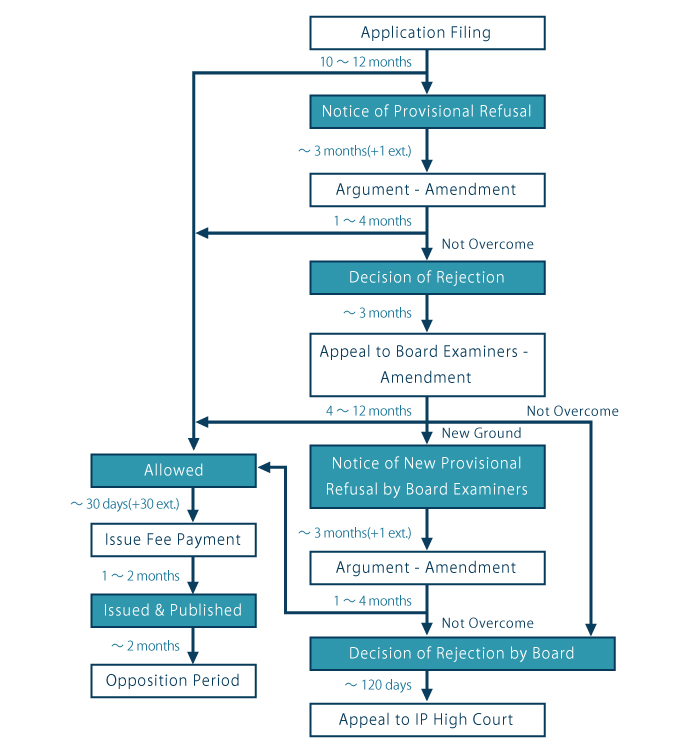
2. Accelerating the Examination
The examination of the domestic trademark application can be accelerated if:
the applicant has filed the same trademark abroad, and
the applicant is already using or prepared to a considerable extent to use the trademark in Japan.
The International Application designating Japan is not eligible for the acceleration.
If the same trademark has not been filed abroad, but you want to accelerate the examination, please contact us.
3. Responding to the Provisional Refusals
These are the most important considerations. It is necessary to refer to the notice from the Japan Patent Office (JPO) for the specific legal grounds of refusal.
(1) Intent to Use (Section 3(1), Main Body)
When the JPO questions the applicant’s intent to use the trademark, the applicant must prove intent to use. This requirement can be satisfied by submitting a simple business plan accompanied by an original, executed declaration. We will send you appropriate forms for the business plan and declaration upon your request. Please also be aware that if a specific qualification is required for performing designated services, this qualification must also be proven.
(2) Distinctiveness (Section 3(1) (i) to (vi))
Trademarks must be distinctive. In responding to a provisional refusal made on this ground, the applicant may explain, for example, that a unique concept is inferred by the trademark, or the trademark will not indicate the quality of the goods considering general consumer’s perception about the mark.
If those options are unavailable, it may be necessary to ensure that the mark is not registrable in Japan so that no other party would be able to obtain registration of the mark. For that purpose, filing an argument or even an appeal to confirm rejection should be undertaken.
(3) Inferred Contents (Section 4(1)(xvi))
When the trademark implies the content of the designated goods, the designated goods must be limited to the goods that include the implied content. Alternatively, the applicant may explain that the trademark does not imply the content considering the real market situation, for example.
(4) Clearness (Section 6(1))
The description of goods or services must be clear. When the examiner’s suggested description is unacceptable, the applicant may alternatively choose a description of the goods or services from a list of standard descriptions, which can be viewed at here, as long as the description is within the scope of the original designation. If none of the standard descriptions matches the actual goods or services, please feel free to send us a pamphlet or a URL for a website that explains the goods or services, and we would be happy to propose an appropriate description.
(5) Classes (Section 6(2))
Classes must be proper for the designated goods or services. This requirement is often satisfied when the goods or services are clarified for satisfying the above clearness requirement. For a reclassification, a new class can be added to a domestic application, but not to the international application filed under the Madrid Protocol.
(6) Similarities (Section 4(1)(xi))
Either the trademark itself or the designated goods or services must be different from those of prior filed trademark registrations or applications. The similarity of two trademarks is largely based on the phonetics of the Japanese language, which is often different from true pronunciation. For example, “r” and “l” are pronounced same in Japan, as are “ce” and “se”.
JPO categorized goods and services into subclasses within each class and mechanically considers the similarities of goods and services by whether they fall into the same subclass. If only some of the goods or services are similar to or overlap with those of the cited trademark, the refusal may be overcome by deleting or limiting the conflicting goods or services.
The following options should also be considered over refusal under Section 4(1)(xi).
a) If the cited mark was registered more than two (2) years ago
If the cited trademark has not been used for the conflicting goods or services for the last three (3) years, the registration of the cited trademark for such goods or services is canceled upon request. We would be happy to search the use of the cited trademark on websites. If a cancelation request is filed, the cited trademark’s registrant must prove use. Otherwise, the goods and services for which the cancellation was requested are deleted. If the conflicting goods or services are maintained, the applicant can still amend its own goods or services.
If the use is not found and two (2) years have passed from the cited trademark’s registration, we suggest keeping your application pending and wait.
b) If the cited trademark application is still pending
If the cited trademark application is still pending and is later abandoned, the provisional refusal will be withdrawn. Therefore, in general we suggest waiting for a final decision on the cited trademark. You can file a petition to suspend the examination and wait for a decision on the cited trademark.
c) Consent from or Temporary Assignment to (the owner of the cited trademark)
If the trademark application for Japan is temporarily assigned to the owner of the cited trademark, the provisional refusal is overcome. The trademark application can be reassigned back to the original applicant after it is decided to be registered. Mere consent from the owner of the cited trademark also overcomes the provisional refusal if the consumers will not be confused by the two trademarks.
We are happy to negotiate with the owner of the cited trademark for a consent or temporary assignment.
*NOTE*
This document provides general information only, and does not serve as a substitute for legal advice for a specific case. For more information, please feel free to contact us.